| |
Back to Index
Zimbabwe
monthly food security update: July 2004
- Zimbabwe faces food access crisis
Famine
Early Warning System Network (FEWSNET)
August 13, 2004
http://www.fews.net/current/monthlies/report/?submit=y&m=1001331&f=zw
Summary
- Although
there is no consensual cereal production estimate for Zimbabwe
in 2003-04, independent production estimates range from 950,000-1,100,000
MT. Zimbabwe will therefore have a serious food access problem,
at least until the next harvest (May 2005). Current estimates
are that food access is very difficult for an estimated 2.5 million
urban and 2.3 million rural people.
- Cereals are
still generally available in most rural districts, from own and
local production, but may become scarce in Buhera, Mutare, Beit
Bridge and Bulilimangwe districts which have not produced enough
cereals to last past July. Another eight rural districts are expected
to use up their cereal harvests within the next four months. By
October, food security will be seriously threatened by cereal
shortages in these districts.
- The Zimbabwe
Vulnerability Assessment Committee estimated that about 2.2 million
people in the rural areas will not be able to meet all their food
needs on their own between July and November 2004, during which
they would require food assistance of at least 52,000 MT.
- The suspension
of general feeding in April, May and June by international food
agencies, in response to Government's announcement that the country
has enough food from the 2003/04 agricultural season's harvest,
has left the majority of highly vulnerable food insecure households
dependent on decreasingly effective coping strategies, with poor
prospects for employment income.
- The availability
of basic foodstuffs has remained stable in most urban markets,
but low income household purchasing power continues to limit food
access. This situation is compounded by very high unemployment
levels and inflation rates.
- Minimum wage
reviews completed in April resulted in a minimum wage increase
of more than 190 percent, from Z$114,594 to Z$341,655 per month.
However, the new wage rate is just enough to cover 30 percent
of the cost of the total Consumer Council of Zimbabwe (CCZ) low
income household basket for June, estimated at Z$1,143,510. The
situation has marginally worsened compared to May 2004.
- Water cuts
lasting for weeks and frequent sewage blockages that go on for
days without being attended to are becoming more of a norm than
an exception in Harare and other towns. This, together with irregular
collection of refuse, is posing a growing health hazard to Zimbabwe's
urban populations.
1. Current
Food Security Situation
1.1 Rural
food security temporarily good in most districts
Cereals are
still generally available in most rural districts from own and local
production, but are becoming scarce in Buhera, Mutare, Beit Bridge
and Bulilimangwe districts which are estimated to have produced
less than four months of their needs and where locally produced
cereal stocks will not last beyond July. Cereal consumption is now
complemented by consumption of sweet potatoes, pumpkins and squashes
that are still available from last season's harvest, particularly
in the Mashonaland provinces. Local shops or relatively accessible
rural service centre shops continue to carry stocks of basic food
such as maize meal, sugar, cooking oil and meat. Mice catching in
the harvested fields are a traditional coping mechanism providing
some rare protein for many poor rural households at this time of
the year.
The suspension
of general feeding in April, May and June 2004 by food agencies,
in response to Government's announcement that the country has enough
food from the 2003/04 agricultural season's harvest, has left the
majority of vulnerable food insecure households dependent on their
own. A small proportion of these households continue to benefit
from targeted feeding schemes such as school feeding, home based
care and feeding programmes for orphans and chronically ill patients.
The majority of the food insecure households have already started
relying on food borrowed from neighbours, friends and relatives,
or by exchanging their labour for food and cutting down on meals.
The situation is relatively better for the poor households with
able-bodied members in the cotton and tobacco growing areas of the
country because here casual employment is easier to find. Smallholder
farmers produced the bulk of the estimated 260,000 MT of cotton
produced last year, and over 80 percent of this crop has been sold,
resulting in a large injection of money into the rural economy of
these areas. Cotton farmers engage a lot of casual labour during
the harvest and can afford to hire casual labour for various on-farm
and off-farm activities.
Despite poor
households' coping strategies and the on-going targeting feeding
in rural areas, a gap remains. The Zimbabwe Vulnerability Assessment
Committee estimates that about 2.2 million people in the rural areas
will not be able to meet all their food needs on their own between
July and November, and during this period, they would require food
assistance of at least 52,000 MT. These food insecure rural households
are found throughout the country. Sub-district level assessments
are urgently required to identify these households and target appropriate
food assistance within the next month to avoid dire consequences.
1.2
Urban food security continues to be threatened by limited real household
income and purchasing power
Even though
basic commodities like maize meal and cooking oil are available
on the market, accessibility still remains a major problem. This
has been further compounded by very high unemployment, low income
and high inflation rates. While there is a downward trend in inflation
rates since January 2004, the rate remains far too high and continues
to erode the purchasing power of all wage earners and pensioners.
The annual food inflation reported by the Central Statistics Office
stood at 430.6 percent in June 2004, shedding off 51.2 percentage
points on the May 2004 rate of 481.8 percent (Figure 1, next page).
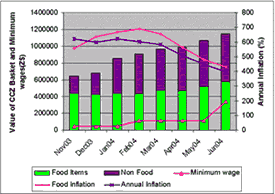
The monthly
expenditure basket for a low income urban household of six, monitored
by the Consumer Council of Zimbabwe (CCZ), stood at Z$1,143,510
in June. This value of the basket is about 7 percent above its May
2004 level and about 436 percent more than the basket's value in
June 2003. Between May and June 2004, the cost of maize meal went
up by 44 percent, that of sugar by 21 percent, tea by 14 percent
and flour 12 percent. It is important to note that there has not
been a significant increase for non-food items; much of the cost
increase has been food items. The value of all food items in the
CCZ basket went up by about eleven percent while that of non-food
increased only 2 percent between May and June 2004.
Over the past
twelve months, rentals for shelter have increased by 400 percent
and a significant number of poor households have been priced out
of the market. They have been pushed to illegal settlements around
the cities and towns. Minimum wage reviews in April resulted in
minimum wage increases for industrial workers of more than 190 percent,
from Z$114,594 to Z$341,655 per month. However, the new wage rate
is just enough to cover only 30 percent of the cost of the total
CCZ low income household basket for June (Figure 1). The situation
has marginally worsened compared to May 2004.
Figure
1: Cost of monthly expenditure basket for a low income
urban household of six in Harare, November 2003 - June 2004
Source:
CCZ, Zimbabwe Congress of Trade Unions and CSO
1.3 Worsening
Water and Sanitation in Urban Areas
Water cuts lasting
for weeks and frequent sewage pipe blockages that go for days without
being attended to are becoming more of a norm than an exception
in Harare and other towns. This, coupled with irregular collection
of refuse and uncontrolled vegetable vendors setting up shop everywhere,
are beginning to pose a serious health hazard to Zimbabwe's urban
population. Improved management of municipalities and urban boards
could address most of these problems, for they are by and large
results of mismanagement. Central Government budgeting should make
provisions for water and sewage infrastructure repairs and development.
2. Food
Security Prospects: August 2004 to March 2005
2.1 Zimbabwe's
cereal production for the 2003/04 agricultural season remains controversial
The question
of how much Zimbabwe produced in cereals during the 2003/04 agricultural
season remains unresolved, at least internally. FAO has estimated
a cereal production of 950,000 MT and FEWS NET has estimated 1.1
million MT, a figure that includes the growing urban production
not counted by FAO. An eleven member Parliamentary Committee on
Lands, Agriculture, Water Development, Rural Resources and Resettlement
was set up at the instigation of the opposition in parliament to
resolve the question. Despite the urgency of the matter, the committee
has not met and is to be reconstituted in the current parliamentary
session which started on the July 20. The lack of consensus of the
cereal harvest and the inaccessibility of government cereal import
figures for the current marketing year make food availability analysis
and contingency planning for international agencies very difficult.
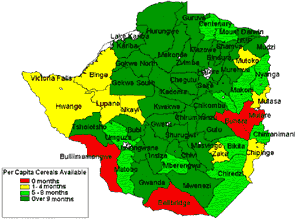
Figure
2: Average Cereals Available (months) to Rural District
Population from the Estimated 2003/2004 Production as at 31 July
2004
Source:
FEWS NET/USGS
2.2 Twelve
Rural Districts Likely to Face Serious Cereals Shortages in the
next Four Months
If all the cereals
produced from the 2003/04 agricultural season were to be shared
equally among all the rural population in each of Zimbabwe's 57
seven districts, four rural districts of Bulilimangwe, Beit Bridge,
Buhera and Mutare would have used up all their maize, millets and
sorghum harvests by the end of July ( Figure 2). A further eight
will be expected to use up their cereal harvests within the next
four months. Food security is seriously threatened by cereal shortages
in these districts.
Marketing measures
to move grain from the surplus districts are urgently needed. Since
livestock sales are an important source of cash for households to
purchase food in the southern districts of the country, it is important
to monitor the functioning of livestock markets and the developments
in the terms of trade between livestock and cereals. Currently the
terms of trade between livestock and grain are in favour of livestock,
but as grain becomes less available in the coming months and livestock
conditions deteriorate with reducing grazing and grazing quality,
grain prices are expected to go up relative to those of livestock.
This will see the food security situation of livestock-based livelihoods
zones, which are dominant in the Matebelelands, deteriorating faster.
Remittances from neighbouring Botswana and South Africa also contribute
significant amounts of food to a marked number of households in
the two Matabeleland provinces; to the extent possible, these need
to be encouraged. Causal labour is expected to be more readily available
in most of the rural districts on the central watershed due to the
improved harvests this year. Most of the estimated 260,000 MT of
cotton, produced predominantly by smallholder farmers, has been
sold, injecting over Z$300 million into Zimbabwe's rural cotton
areas. This is going to help poor households without adequate harvests
to supplement their food stocks in most districts of the three Mashonaland
provinces. However, there will still be poor households who will
fail to meet all their food needs on their own in both the cereal
surplus and deficit areas, and these households will most certainly
require food assistance. The Zimbabwe Vulnerability Assessment Committee
estimates this food insecure population will reach 2.3 million at
the height of the hunger period in October/November 2004.
2.3 Improved
Disposable Incomes
The government
review of the non-taxable income has raised the threshold for individuals
from Z$200,000 to Z$750,000 per month, effective from September
1. This will increase disposable incomes of all taxpayers. An individual
who currently earns a taxable income of Z$750,000 per month takes
home about Z$521,250. In September, the same individual will be
taking home the whole Z$750,000, if income tax is the individual's
only salary deduction.
The tax reform
by Government is expected to improve the ability of lower income
households, with members that were lucky enough to be earning taxable
income, to access more food and other basic necessities with their
September 2004 and future earnings.
3. Recommendations
- The United
Nations should continue to be engaged in dialogue with the Government
to secure greater collaboration from the Government for continuing
food aid and recovery programmes.
- The Humanitarian
agencies and the major donors need to redefine the scope of their
humanitarian work to include more activities to do with general
livelihoods recovery and as well as agricultural recovery.
- Sub-district
level assessments are urgently required to identify the food insecure
households and the appropriate food and non-food assistance required
to avoid dire consequences.
Visit
the FEWSNET website
Please credit www.kubatana.net if you make use of material from this website.
This work is licensed under a Creative Commons License unless stated otherwise.
TOP
|


